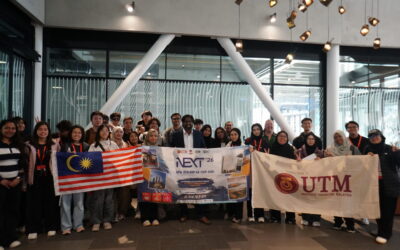
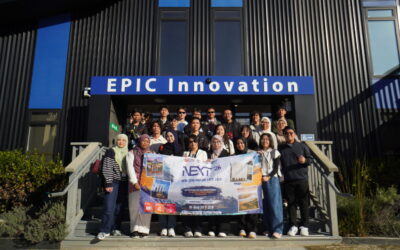
CHRISTCHURCH, 1 Sep – Advancing its focus on immersive learning and XR innovation, the New Zealand XR Trip 2026 (NEXT’26) delegation, comprising Bachelor of Computer Science (Graphics and Multimedia Software) with Honours students from the Faculty of Computing, Universiti Teknologi Malaysia (UTM), continued its academic journey at the University of Canterbury (UC). The day featured an insightful visit to HIT Lab NZ to explore emerging technologies, followed by a hands-on motion capture workshop that gave students practical exposure to immersive technologies.

The session at HIT Lab NZ began with expert insights from Prof. Dr. Heide Lukosch, Prof. Dr. Stephan Lukosch and Dr. Susanne Schmidt. They introduced students to the concept of meaningful human augmentation, exploring how technology can enhance human capabilities and create more purposeful interactions in future digital environments.


During the visit, the delegation tested the Nova Ball—a massive, untethered spherical virtual reality (VR) motion simulator that allows users to experience unlimited 360-degree movement. Alongside this immersive research prototype, students also explored advanced head-mounted displays (HMDs) and headsets, as well as other innovative technologies within the HIT Lab, gaining a closer look at how interactive systems, embodied AI and human-centred technologies can shape future digital experiences.

The programme then transitioned to the Len Lye Building (School of Product Design) for a dedicated motion capture (MoCap) workshop led by Prof. Dr. Adrian Clark. Students explored avatar creation and experienced motion capture technology firsthand through a practical demonstration using a MoCap suit, further strengthening their understanding of how captured movement can be integrated into digital experiences.


The comprehensive experience across both facilities provided the NEXT’26 students with a practical understanding of how motion capture, digital avatars, and embodied AI can converge to create more immersive forms of human–computer interaction.
This hands-on exploration directly complements ongoing research and interests in immersive technology at UTM, particularly within the Virtual, Vision and Visualization Research Lab (ViCubeLab) and the Mixed and Virtual Environment Lab (MivieLab). With the NEXT’26 delegation comprising students from the Faculty of Computing enrolled in the Bachelor of Computer Science (Graphics and Multimedia Software) with Honours, this international exposure offers invaluable real-world context that enriches their specialised academic studies and strengthens their preparation for future careers.
The experience also connects their classroom learning with practical applications of XR and immersive technologies, providing a broader context for their specialised field of study. By engaging directly with research prototypes and practical motion capture systems, students were able to observe how concepts discussed in academic settings translate into real-world applications.


0 Comments